The exuberant, irreverent and surprising films of Chris Langdon have recently made a welcome return to the screen after many years out of circulation. A student of Pat O’Neill, Robert Nelson, and John Baldessari, Langdon was incredibly prolific, producing a large body of work in painting, sculpture, film, photography, and graphics. Her legendary film work, created between 1972 and ’76, is often a brash and funny mix of the so-called high and low. Never ponderous or needlessly abstruse, Langdon’s films are direct, formally unique, and full of intuitive flair and wild humor; they delight in provoking and challenging not only modes of artmaking but our reception of art and its purported messages. “Chris Langdon is the first punk filmmaker and the most important unknown filmmaker in the history of the Los Angeles avant-garde.” (Thom Andersen)
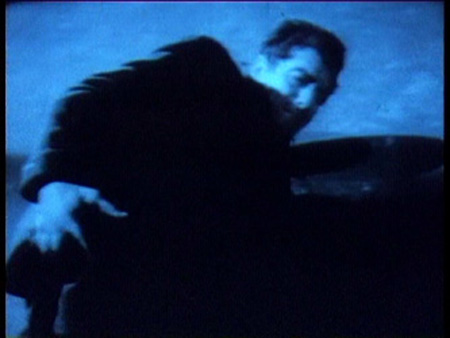
A compact version of Henry Hathaway’s 1947-movie, refilmed during a 1973-television broadcast with a super 8 camera: 4 or 5 frames from each shot, so that the narrative editing strategies of the whole movie become apparent within 4 minutes. Part of K. Wyborny’s 90-minute film Elementary Film History (1974) and of his 25-minute art-gallery installation Histoire du Cinéma (2004) “I’ve always been very interested in the narrative. My cinema has to do with stretching the narrative until it kind of collapses. I care about the structures, about what they do to one’s mind. Maybe this is being analytical. But I analyze the time structures while I proceed in building them. Structure in itself doesn’t interest me. I am interested only in specific ones which then I kind of try to analyze.” (KW)
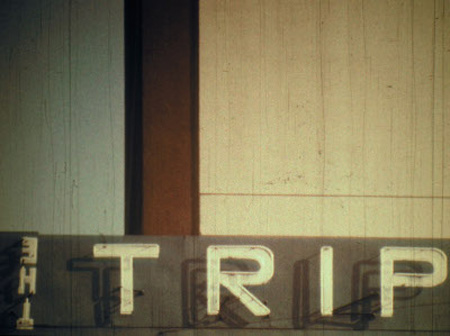
“I consider Thom and Malcolm’s film to be groundbreaking in its brilliant demonstration of the power of a rule to construct a film that unifies shots taken at different times and places. And it also noteworthy for the new model of the documentary film that it proposes. In describing his film as a parody of montage, Thom is being too modest, if not deliberately misleading. The brilliance of --- ------ is that it refuses the power of montage as that idea has been conventionally understood, only to rediscover its power in a different form, on a new plane.” (MF)

“My film takes its material from the situation that people work for four days on an image that is supposed to be published in the centerfold of the Playboy magazine. The naked woman in the centerfold is like a sun with a revolving system around it: Culture, business, living! (You cannot see or film into the sun). One can imagine that people who have to produce an image of such gravitational force have to do it with the same diligence, seriousness, and responsibility, as if they were involved in nuclear fission. Today, printing companies and publishing houses, the advertisement business, hotels and clubs, galaxies of millions of Dollars, a whole commercial cosmos circle around the naked girl in the centerfold of the Playboy magazine; every month, a new girl takes center stage. A single point has no expansion and is invisible. That is what we have filmed.” (HF)