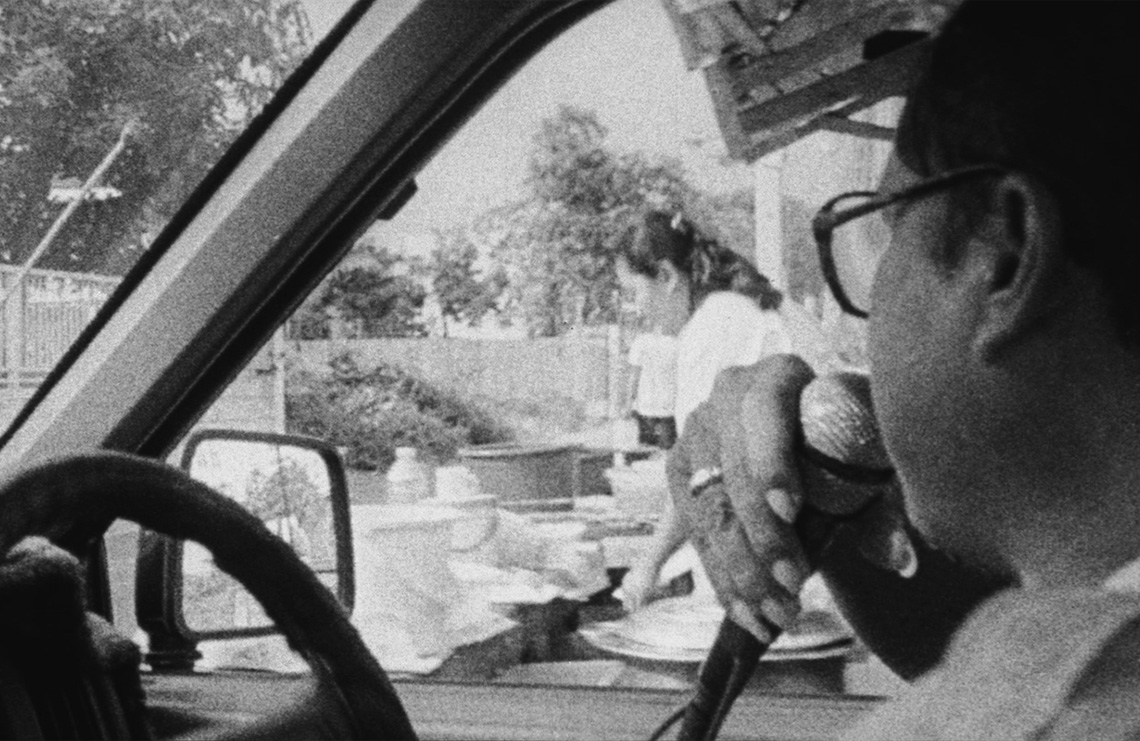
Inspired by the surrealist procedure called cadavre exquis (exquisite corpse), Apichatpong Weerasethakul — who is credited here as a mere “story editor” — and his crew meander from the northern provinces of Thailand to the south and, in a series of chance encounters, ask street vendors, farmers, local theater groups, and children to collectively tell a story. Each storyteller has to continue the tale where it had been left off. With each new encounter, the narrative evolves and changes, absorbing melodramatic and supernatural elements rooted in Thai soap operas and folklore, and extending the telling into the untold. Together, they slowly turn a fairly straightforward exposition into a polyphonic and heteroglossic tale of humans, animals, and aliens. The daisy-chain narrative of interlocking vignettes is shaped through speech or sign language, song and dance or radio broadcast, and grows more outlandish by the mile. Filmed on 16mm over the course of three years during Thailand’s economic crisis of the late 1990s, Mysterious Object at Noon already shows the rigorous attention paid to intricate sound recording and design, as well as uncanny narrative structures, that would characterize the director’s later film and video work, highlighting the full potential of cinema as a resonant form of composition and fabulation. “Less an anomaly than a secret skeleton key to Weerasethakul’s work... Mysterious Object at Noon revels in the myriad ways a story can be transmitted.” (Dennis Lim)
“You’re likely to be utterly enchanted by this unique dish of entertainment that may be the beginning of a new art form: Village Surrealism. Mr. Weerasethakul’s fifilm is like a piece of chamber music slowly, deftly expanding into a full symphonic movement; to watch it is to enter a fugue state that has the music and rhythms of another culture. It’s really a movie that requires listening, reminding us that the medium did become talking pictures at one point.” (Elvis Mitchell)
Restored in 2013 by The Film Foundation’s World Cinema Project and the Austrian Film Museum. Restoration works carried out at the Austrian Film Museum, LISTO laboratory in Vienna, Technicolor Ltd in Bangkok, and Cineteca di Bologna/L’Immagine Ritrovata laboratory, in close collaboration with Apichatpong Weerasethakul.