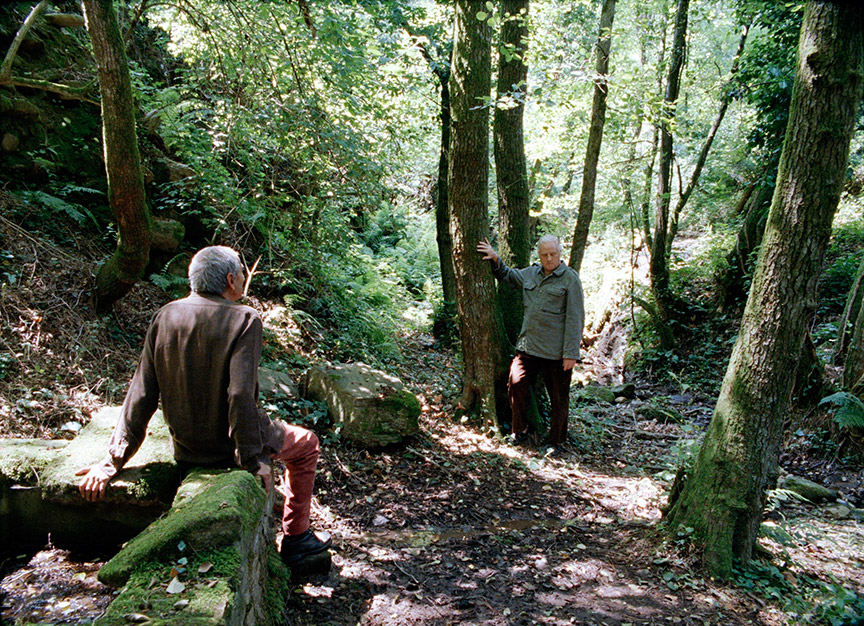
Jean-Marie Straub’s first film without Danièle and a love poem to her. Straub once again chose a conversation from Dialogues of Leuco, Cesare Pavese’s collection of short stories that was also on the basis of Dalla Nube alla Resistenza (1979) and Quei Loro Incontri (2006) when they were still together. It is not just any dialogue, but Pavese’s most personal one that tears open a painful abyss between a mortal, Endymion, and the woman he loves, the goddess Artemide. Straub stages the dialogue in which Endymion tells the story of his encounter with Artemide to a stranger on the slopes of the forest of Buti, the small Tuscan town where he and Huillet traditionally shot all of their Italian-language films since Sicilia! (1999) with a group of non-professional actors from the local Teatro Comunale. As a kind of tomb, the film starts with a black screen lasting four minutes, accompanied by the final verse from Gustav Mahler’s Abschied (Farewell) from Das Lied von der Erde (The Song of Earth). This music is echoed at the end by Heinrich Schütz’s seventeenth-century Klagelied (Song of Lament) – two mourning-works for the composer’s young daughter and late wife, respectively, reappearing here as a ciphered message from the one who remained to the one who remains in him. The film thus rises from a chant in the dark to disappear in the woods with the whisper of the wind after a brief journey of the camera through the forest, now empty and silent of human voices, but inhabited by the memory of Huillet, her past presence and present absence. “Nature has ten million times the imagination of the most imaginative of artists.” (Jean-Marie Straub)