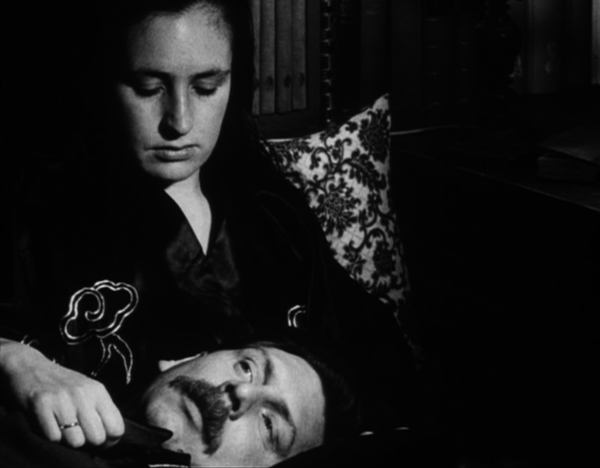
Straub-Huillet’s first released film is a powerful distillation of Heinrich Böll’s novel Billiards at Half Past Nine (1959), charting the origins and legacy of Nazism, and the moral demands of obedience and sacrifice within the German bourgeois family.
“Nicht Versöhnt is the story of a frustration (frustration — of violence: that which Saint Joan of the Stockyards invokes when she cries out, “Only Violence Helps Where Violence Rules” — of a people who failed in their revolution of 1849 and who have not freed themselves from fascism). I have deliberately set aside all that the novel included of the picturesque and the satirical. And instead of putting my mind, like Böll, like the author of Citizen Kane, or like Resnais, to a puzzle, I have risked a lacunary film (“lacunary body: body composed of agglomerated crystals that leave intervals among them”, Emile Littré). It is to the incarnation of the characters that I put my mind. They are epic characters, in the Brechtian sense. The bourgeois becoming politically conscious (to an extent limited by their condition) of Nazism and of its continuity with what preceded it, well before 1933 (anti-communism and bourgeois moral values, such as Ernst, Ehre, Treue, Ordnung), and with what [has] followed it since 1945 (anti-communism and political opportunism). They express themselves with the words of Böll, but in the manner of the characters of Jean Rouch. We always recorded the sound at the same time as the images. Like Jean-Luc Godard, “I have always loved the sound of the first talkies; it had a great truth, for it was the first time that one heard people speak,” and it is indeed the first time in Germany, since the war!” (Jean-Marie Straub)