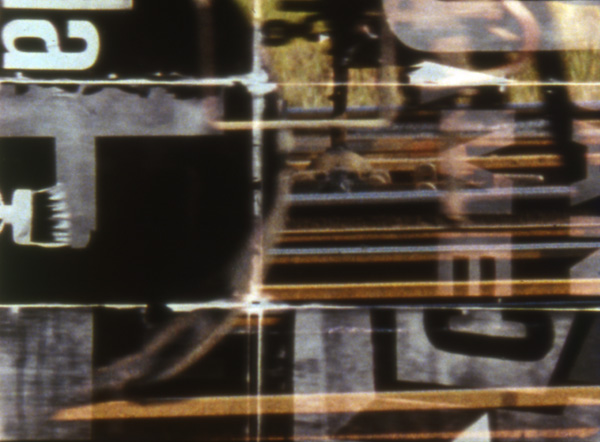
“Inspired by a lesson from Erik Satie: a film in the form of a street—Castro Street—running by the Standard Oil Refinery in Richmond, California… switch engines on one side, and colorful Standard Oil refinery tanks, smoke stacks, and buildings on the other—the street and film, ending at a lumber company, colored red. All visual and sound elements are from the street, progressing from the beginning to the end of the street, black and white on one side (secondary), and the other in color (primary). Editing/composing occurred while listening to an Indian raga based on similar apparent opposition.” – B.B.
The emergence of a long-switch engineer shot (in black and white) is to the filmmaker, the essential image of consciousness. Baillie worked with outdated Anscochrome T100 and high-contrast Eastman negative copy film in March of that year, and editing the film—using two projectors—at Morning Star Ranch during April and May; the soundtrack was originally two-track stereo but, of necessity, is monaural on the film print; the sound, like the picture, is from the street itself—many sounds are altered by octave via playback speed. Technically, this kind of film begins stretching the limitations of conventional cinema (single screen; conventional recording devices, separate picture and sound; ‘given’ photographed frame; established printing methods).